
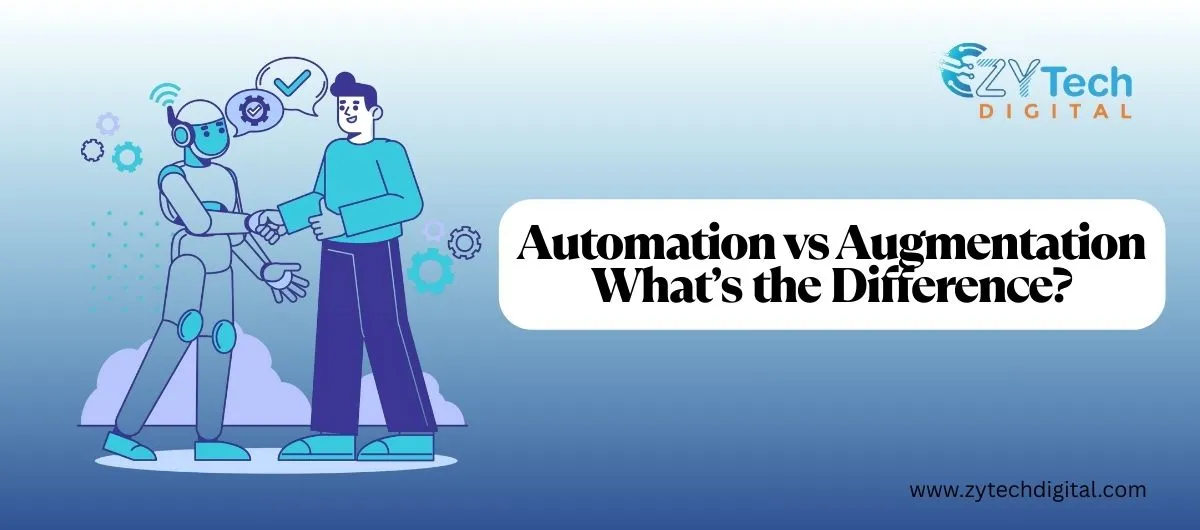
In a world increasingly shaped by rapid advancements in artificial intelligence (AI), machine learning, and robotics, the terms “automation” vs “augmentation” are often thrown around. Early in my career, I used these words interchangeably, assuming they meant essentially the same thing. But as I delved deeper into the digital transformation landscape, I realised there is a crucial difference between the two. Understanding this distinction has helped me adapt to the changing nature of work and empowered me to make smarter business and career decisions.
So today, I want to break down the key differences between automation vs augmentation, explore real-life examples, discuss their benefits and challenges, and ultimately help you understand how each plays a role in shaping the future of work.
Contact our career specialists
What is Automation?
Automation is the use of technology to perform tasks with minimal or no human intervention. It’s all about creating systems that can operate independently, handling repetitive, rule-based activities. Think of a manufacturing robot assembling car parts or a chatbot answering common customer queries.
Definition: Automation is the process of using technology to perform tasks that were previously done by humans, often to increase efficiency, reduce errors, and lower operational costs.
Real-Life Examples of Automation:
- Manufacturing: Robotic arms on assembly lines
- Banking: Automated teller machines (ATMs)
- Customer Service: AI-powered chatbots
- Retail: Self-checkout kiosks
- Marketing: Automated email campaigns
The goal of automation is to replace human effort in repetitive tasks, freeing up time for more strategic activities or reducing labour costs altogether.
What is Augmentation?
On the other hand, augmentation doesn’t replace human input—it enhances it. Augmentation uses technology as a tool to help humans do their jobs better. Instead of taking over the task, it acts like a digital assistant, increasing our capabilities and decision-making power.
Definition: Augmentation is the use of technology to enhance human abilities, allowing people to work more efficiently, accurately, and creatively.
What is an Augmented Workforce?
Real-Life Examples of Augmentation:
- Healthcare: AI helping doctors interpret X-rays more accurately
- Finance: AI tools assisting analysts in identifying market trends
- Writing: Grammar tools like Grammarly offer suggestions for clearer communication
- Design: AI-enhanced software like Adobe Sensei is improving image editing
- Sales: CRM platforms that suggest the best time to follow up with leads
The goal of augmentation is to empower humans by supporting their work with technology.

Automation vs Augmentation: Core Differences
To put it simply:
- Automation = Replacement
- Augmentation = Enhancement
Let’s break this down even further with a side-by-side comparison:
| Aspect | Automation | Augmentation |
| Goal | Replace human tasks | Assist with human tasks |
| Human Involvement | Minimal or none | High |
| Examples | Robots, chatbots, RPA | AI assistants, predictive tools |
| Key Benefit | Efficiency and cost savings | Accuracy and decision-making |
| Limitation | Lack of creativity and empathy | Still relies on human labour |
Benefits of Automation
I’ll admit—automation has its perks, especially in environments where speed and consistency are key. Here are some of the major benefits:
- Efficiency: Automated systems work faster than humans and don’t need breaks.
- Cost Savings: Businesses save on labour costs.
- Consistency: Machines produce the same result every time.
- Scalability: Automation can easily be scaled up or down depending on demand.
- Data Accuracy: Reduces human errors in data entry and calculations.
Challenges of Automation
However, automation also has its drawbacks:
- Job Displacement: Workers in repetitive jobs risk being replaced.
- High Setup Costs: Initial investment in automation technology can be expensive.
- Limited Flexibility: Machines can struggle with tasks that require creativity or empathy.
- Security Risks: Automated systems are vulnerable to cyber threats.
Benefits of Augmentation
Personally, I find augmentation more exciting because it brings out the best in both humans and machines. Here’s what it offers:
- Increased Productivity: Workers can accomplish more with AI assistance.
- Better Decision-Making: AI can analyse massive data sets quickly.
- Job Satisfaction: Employees focus on meaningful tasks instead of repetitive ones.
- Customisation: Augmented tools can adapt to different users and situations.
- Human Creativity: Machines handle the grunt work, while humans innovate.
Challenges of Augmentation
Still, augmentation isn’t without its challenges:
- Training Needs: Workers must learn how to use new tools.
- Dependence on Technology: Over-reliance can create skill gaps.
- Cost of Implementation: Though not as high as full automation, it’s still a factor.
- Data Privacy: Many augmented tools use personal data, raising ethical concerns.
When to Use Automation vs Augmentation
In my consulting experience, I often advise companies to assess their operations carefully before choosing between automation vs augmentation. Here’s a simple rule of thumb:
- Use Automation for tasks that are repetitive, predictable, and don’t require human judgment.
- Use Augmentation for tasks that benefit from human intuition, empathy, and creativity, but can be improved with data or computational support.
Example: A hospital might use automation to schedule appointments, but use augmentation to help doctors interpret lab results.

Future of Work: Automation vs Augmentation Together
Here’s the good news: automation vs augmentation aren’t enemies. In fact, the future of work lies in combining both strategies. Many companies are adopting a hybrid approach where automation handles the mundane, and augmentation enhances the meaningful.
Example: In modern customer service centres, chatbots handle basic inquiries (automation), while live agents receive AI-generated suggestions during calls to provide better service (augmentation).
Final Thoughts on Automation vs Augmentation
Understanding the difference between automation vs augmentation has changed the way I view technology. Instead of fearing replacement, I now focus on how I can work with technology, not against it. Automation is excellent for increasing efficiency and reducing costs, while augmentation empowers us to be better at what we already do best: thinking, empathizing, and innovating.
Whether you’re an employee wondering how AI will affect your job or a business leader trying to streamline operations, remember this:
- Automation replaces. Augmentation enhances.
Embrace both where they make sense, and you’ll not only survive the digital revolution—you’ll thrive in it.
RELATED: Augmented Connected Workforce
Frequently Asked Questions (FAQs) about Automation vs Augmentation
Automation refers to using technology to perform tasks without human intervention, often replacing manual work. Augmentation, on the other hand, enhances human abilities by assisting workers with tools like AI, data analysis, or predictive insights. In simple terms, automation replaces humans, while augmentation supports them.
Not all jobs, but many repetitive and low-skill tasks are at risk of being automated. However, augmentation will create new roles by enhancing human capabilities, leading to the emergence of collaborative human-AI workflows.
Augmentation helps businesses by improving decision-making, increasing productivity, and enhancing employee performance. It allows staff to focus on high-value tasks while technology handles the repetitive or data-heavy parts.
Absolutely. Many modern workplaces use a hybrid model, where automation handles routine operations, and augmentation supports human decision-making. This approach maximizes efficiency without losing the value of human insight.
Neither is inherently better—it depends on the task. Automation is ideal for repetitive, rule-based jobs, such as data entry or manufacturing. Augmentation is best for tasks requiring creativity, judgment, or empathy, such as healthcare or marketing. The most effective strategy often combines both.
Fill The Form Below
